Asian Traditional Archery Research
Network
Chinese Archive
The
Archery Tradition of China by Stephen Selby
Re-printed with permission from INSTINCTIVE
ARCHER MAGAZINE

Qi
Ji-guang's Archery Method
Qi Ji-guang was born into a military family and learned much from his father.
He was appointed general in 1555 and won a decisive victory over the pirates at
Taizhou in 1561. He worked effectively together with Yu Da-you to battle
against the Japanese in
The file contains the Chinese original with illustrations and English translation by Stephen Selby in parallel text (© Stephen Selby 1998). There are two illustrations.
Qi Ji-guang's Archery Method (Adobe Acrobat .pdf file. 100Kb.)
Illustration from
the Wu Bei
Wu Bei Yao Lue means ‘Outline of Military Preparedness’. It was written by Chen Zi-yi in 1638. One section called 'The Theory of Archery' contains some interesting woodblock illustrations. This one shows the classic Ming period position for archery on foot. The original explanations in Chinese have been translated into English.
Illustration from the Wu Bei Yao Lue

'Guan Shi Xin Zhuan' ('Concentrating the Mind to Pierce a Flea') is a work in Chinese by Ji Jian, published in 1679. The title refers to an old story recounted in the writings of the ancient Chinese Daoist philosopher, Lie Zi, in which a famous archer improves his concentration by staring at a flea until it appears to be as big as a cartwheel. The Guan Shi Xin Zhuan is long out of print and is difficult to find.
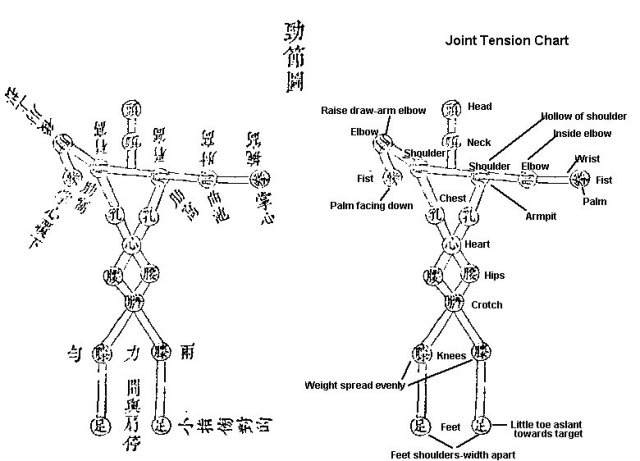
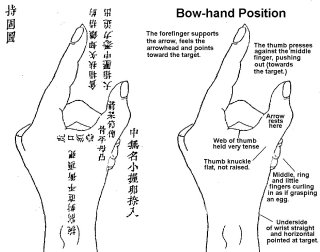
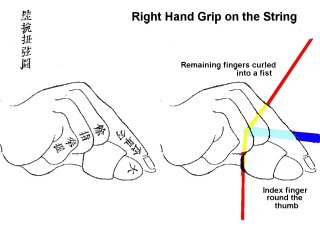
'Guan Shi Xin Zhuan' contains some interesting and unique woodblock illustrations. Bow-hand and string-hand positions are particularly clearly shown. Also, there is an interesting diagram illustrating joint tension throughout the body. Only the Chinese text is available at the moment. However, we offer the English translations of some of the woodblock illustrations.
The ATARN archive version reproduces a Qing Dynasty copy held in the Hua
Dong Teacher's
- 'Guan Shi Xin Zhuan' Chinese text with illustrations. (Adobe Acrobat .pdf file. 388Kb.)
- Illustration of joint tension with English translation.
- Illustration of bow-hand position with English translation.
- Illustration of string-hand position with English translation.
The above items © Stephen Selby, 1998

'Huang Zheng-nan's Archery Method' by Huang Bai-jia
Huang Bai-jia (1634 - 1704) was a student of Huang Zheng-nan,
promoter of the Nei-jia
Huang Zheng-nan Archery Method. (Adobe Acrobat .pdf file. 32 KB.)
Способы стрельбы из лука Чжэннаня.. Huang Zheng-nan's Archery Method' translated and annotated in Russian by Alexey Pastukhov

'She
Lue' A previously-unpublished manuscript on
archery from Beijing University Library, originally copied in 1839. Transcribed
and edited by Stephen Selby. Chinese version only (150 KB .pdf file). This work
follows the

'Makiwara Madness' is a short essay by the Ming
Dynasty author Gao Ying. In his 1637 archery textbook, "The True
Method of Military Archery". Gao Ying devoted a centre-section in his book
to 'Identifying Idiocy'. One of his themes was senseless and undisciplines
shooting at the makiwara.
Perfecting
the Mind and the Body by
Stephen Selby. An article which explores the interrelation between the
study of archery, the principles of study-discipline in
the 'Great Learning' ('Da Xue') of Confucius,
and the practice of Qigong in the archery
tradition of
Whistling Arrows and Arrow Whistles by Liao Wanzhen, Trans. Stephen Selby. An article specially
written for ATARN by Liao Wanzhen of
Making Chinese Arrows. Photographed by Romain Berard. Master Yang Fuxi of Ju Yuan Hao demonstrates how traditional arrows are made. New
Cross-section Analysis of an Old Chinese Bow by Stephen Selby. Sections through an early 19th Century Chinese horn and sinew bow allow us to peek inside the workings of the bow, and we catch out the craftsman up to some dirty tricks!
The Crossbows of
South-West China. Stephen
Selby, 1999. A study of
the construction and usage of national minority crossbows in
The History of Ju Yuan Hao Bowmakers of Beijing. Translation by Stephen Selby. The original author of this article is the direct descendant of the old firm. His full name has not been revealed.
Chengdu Chang
Xing Bowyer's Descendants Rediscovered. Translation by Stephen Selby. Original
articles translated and re-published on ATARN with permission of
Interview with
Wu Yonghua, daughter of the last bowyer
of
Thingies Up-close and Personal Stephen Selby, 2000 A discussion paper on bronze bow fittings (or is that what they were?)
Some Correspondence on Repeating Crossbows. An exchange of email between ATARN members.
'Some Interesting Bows' An exchange of email between ATARN members on the Leather Wall.
The Chinese Repeating Crossbow reproduced from Ralph Payne- Gallwey 'The Crossbow'
Chinese Bow Holsters and Quivers of the Qing Dynasty. Stephen Selby. Photographs and descriptions of three sets of Chinese quivers and bow-holsters.
A Crossbow Mechanism with Some Unique Features from Shandong, China. Stephen Selby. (Heavy on graphics.)
Chinese Horseback Archery translated for ATARN by Stephen Selby with notes by Bede Dwyer. These documents can only be read on an XML-enabled web-browser.
Early Archers' Rings by Bede Dwyer. This article discusses the history of
archers' rings mainly by reference to Chinese rings. Other rings are, however,
discussed.
Stephen’s Drawings of the Yanghai Bows.
Done On-Site at Yanghai and
(Raw images – no fancy editing)
Up-dated 09 October, 2005